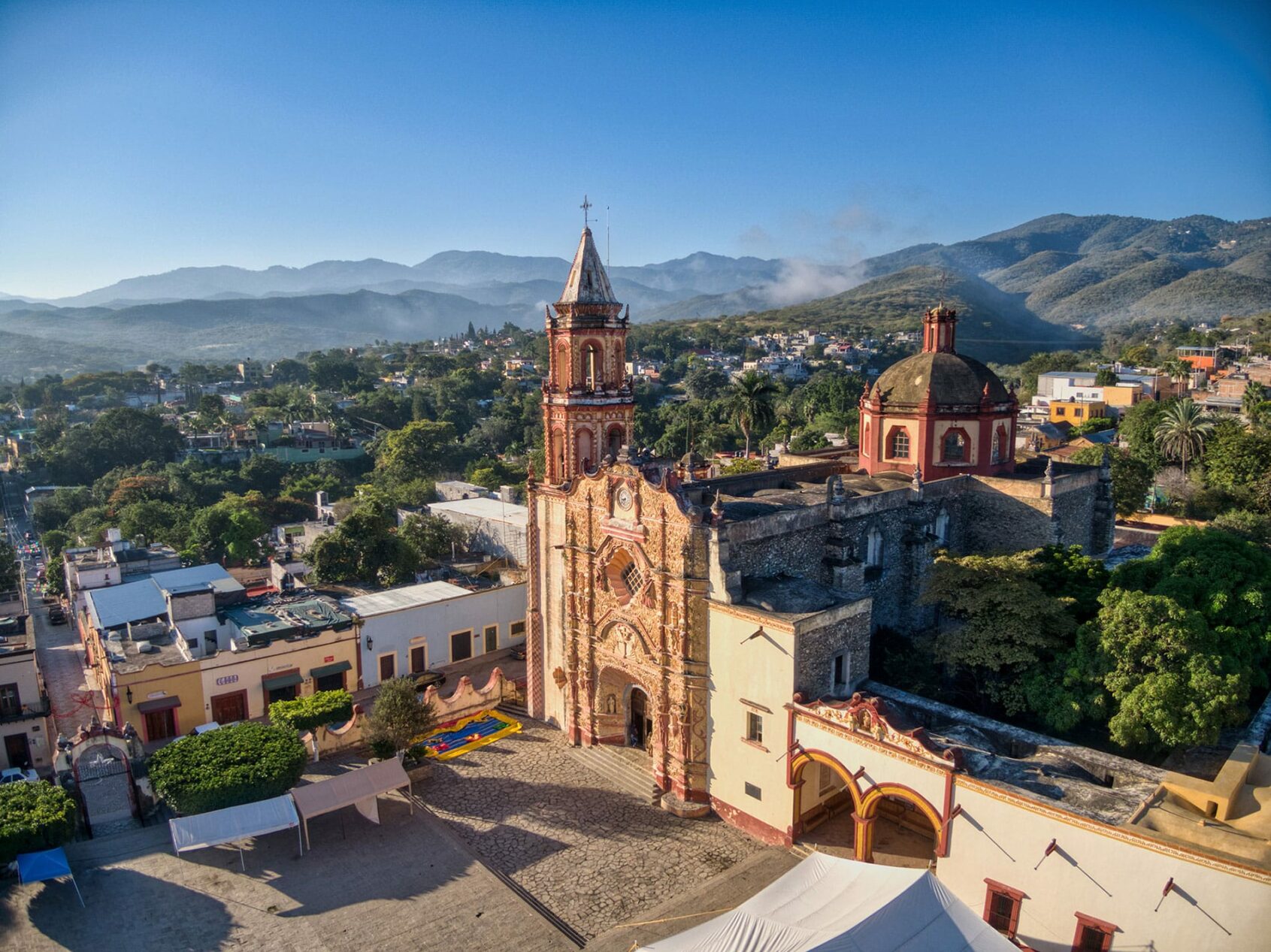
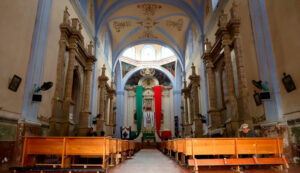
 It was the first to be built, and was even founded before Fray Junípero de Serra arrived in 1744.
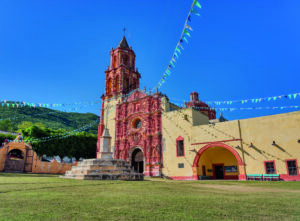
It is dedicated to the apostle Santiago, and is located in front of the main square of Jalpan de Serra. It is made up of an atrium, cloister, pilgrims' portal and the church, with a chapel in the annex on the left side.
Its stucco and stone façade is easily distinguished because it contrasts the ocher of the pilasters with the yellow of its decorative details, which have a saffron color and are decorated with many flowers. Each one of the facades of the Missions, has a meaning, created from the symbolism of its decorations, in this one the meaning is "The Defense of the faith".
The main features of the ornate portal on the façade are Our Lady of the Pillar and the Virgin of Guadalupe, as well as a double-headed eagle, symbolizing the fusion of the two cultures.
European elements include images of St. Dominic and St. Francis of Assisi and the Franciscan coat of arms on the arms.
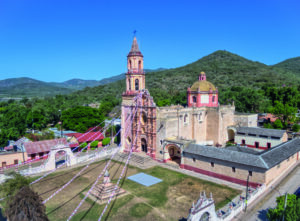 Also located in the town of Jalpan, it is likely that this mission was built by Juan Ramos de Lora, who lived there from 1761 to 1767.
The structure is similar to that of Jalpan and Landa. It has a temple with a Latin cross plan, a choir area, a sacristy, an atrium with a cross, and chapels in the corners called "posas chapels".
It has the most elaborate façade of the five Missions, with three bodies, a pediment, four columns, profuse plant decoration with ears of wheat. The basic theme of the façade is "Mercy", represented by the Virgin Mary and other saints.
The lower body has sculptures of Saints Peter and Paul. The second body has sculptures of Saint Joachim and Saint Anne, with the Virgin Mary in her arms and a hole in the center. There are also images of the Passion symbolized by nails and a spear. This niche contained an image of Our Lady of Light, which is currently empty. Between the second and third bodies, there is a large window and, above it, a representation of the stigmata of St. Francis of Assisi.
The main cross, at the top, represents redemption with the crosses of Calatrava and Jerusalem on either side. Indigenous elements are found inside, with an image of a jaguar and a person with Olmec characteristics. The dome of the tower is shaped like a pyramid with a baroque iron cross at the top.
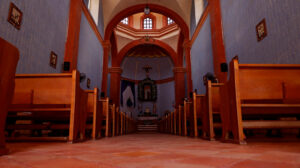 It is located 40 kilometers from Jalpan, in the municipality of Arroyo Seco. It is the smallest of the missions and was probably built in 1754. It is dedicated to the Archangel Saint Michael, on its doors are represented Saints Peter, Paul, Ferdinand and Roque. Concá is a pame word, which means, "with me".
The decoration features large flowers, foliage, thick figures in indigenous style, and figures of the sun and moon, a clear allusion to the duality of the universe. It is distinguished by an image of the Holy Trinity at the top along with a rabbit (pame symbol) and the two-headed eagle; its façade represents "The Victory of Faith".
 Located in Landa de Matamoros, it is dedicated to Our Lady of the Immaculate Conception; it was built between 1760 and 1768 by Miguel de la Campa, being the last of the missions to be built.
On its façade it represents "The City of God", and brings together images of Christ, archangels, apostles, martyrs and nuns, as well as a bell tower on one side. Inside, there are medallions on the ceiling of the main nave, beginning with that of Saint Michael the Archangel, with his traditional iconography, followed by Juan Duns Escoto, in one hand holding the Immaculate Conception and in the other a pen, with which through writing he tirelessly defended the dogma of Mary. And again Saint Michael in the center of the transept of two other archangels, Raphael and Gabriel.